Knowledge Zone · Card 2 of 13
The rocket equation
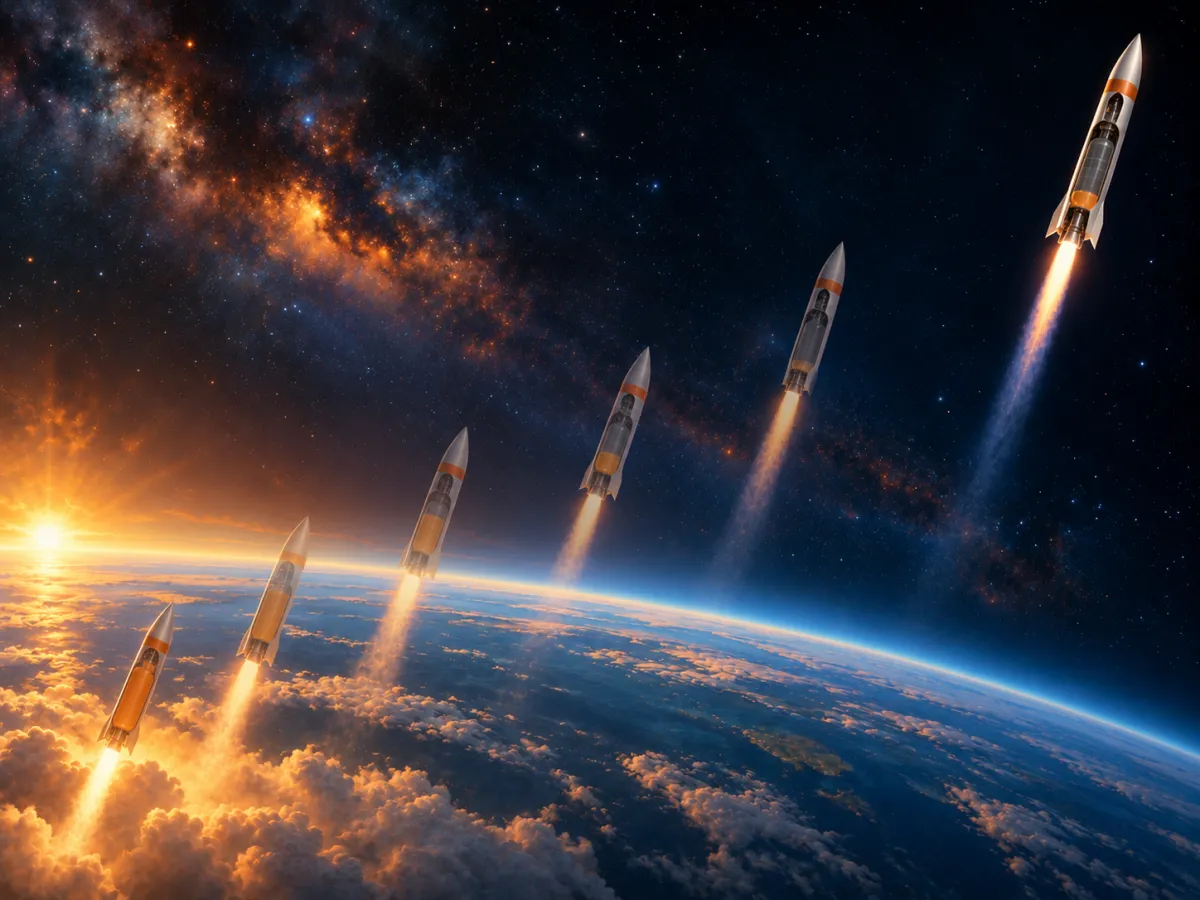
A rocket cannot buy speed with propellant at a fixed rate, because the propellant it has not burned yet is cargo it must also accelerate. Tsiolkovsky's answer is a logarithm: Δv = Isp × g₀ × ln(wet mass / dry mass). What you get depends on the ratio of full to empty, not on the size of the tank, and a logarithm punishes anyone who wants more by asking for exponentially more.
The fuel-load slider is that equation with a handle on it. The label beside it prints the budget live: the Scout at a full tank reads Δv 14.2 km/s. Halve the propellant and it does not halve — it reads 11.2 km/s, still 79% of what you had for half the fuel.
Read the same numbers the other way and the cruelty shows. Taking the first 10% out of the Scout's tanks costs 0.5 km/s. Taking the last 10% out — going from 60% to 50% — costs 0.8. The nearer you are to empty the more each drop is worth, which is exactly why the final stage of a real rocket is the small one and why nobody solves a Δv shortfall by bolting on a bigger tank.