Knowledge Zone · Card 7 of 13
Escape velocity
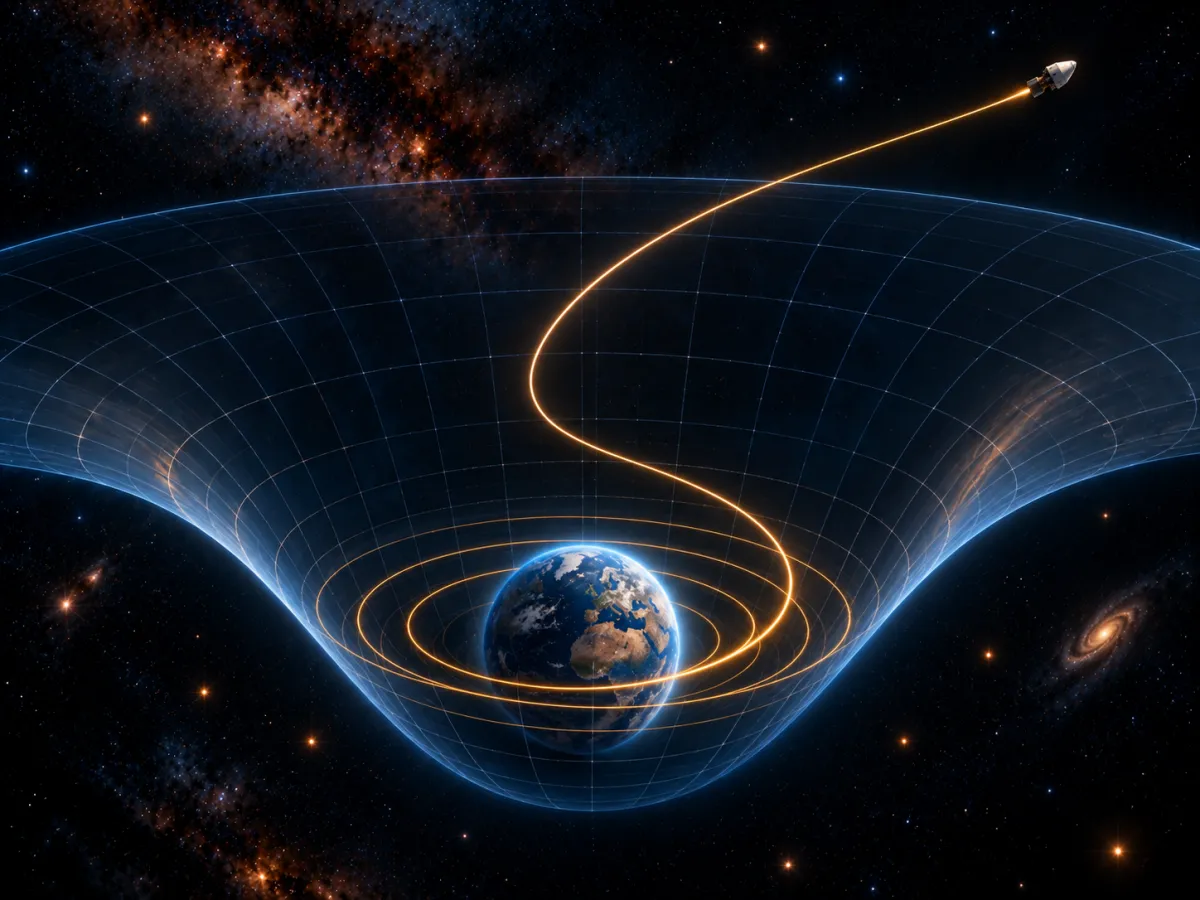
Escape velocity is the speed at which a ship's kinetic energy finally matches the whole depth of the well it is in — enough to coast away and never come back, without burning again. It is a clean √2 times circular speed at the same radius, always, for every body and every altitude. From the Scout's 157 km parking orbit that is 7 814 m/s of orbiting against 11 051 m/s of escaping, and 11 051 ÷ 7 814 is 1.4142.
The gap is what a departure has to buy: 3 237 m/s from that orbit just to be free of Earth, arriving at the edge of its influence with nothing left over. Going to Mars needs that and 2 945 m/s of leftover speed once out there. Yet the cockpit charges only 3 622 m/s for the whole thing — 386 more than escaping to nowhere at all.
The missing 2 559 m/s is the Oberth effect. Energies add, speeds do not, so the burn is √(v∞² + v_escape²) − v_circular and not v_escape + v∞. A burn made deep in the well, where the ship is already doing 7.8 km/s, buys far more than the same burn made out in the open. It is why the game charges the parking orbit your launch actually reached rather than a constant: from 400 km the same departure costs 3 571 m/s against 3 624 from 150.