Knowledge Zone · Card 8 of 13
The Hohmann transfer
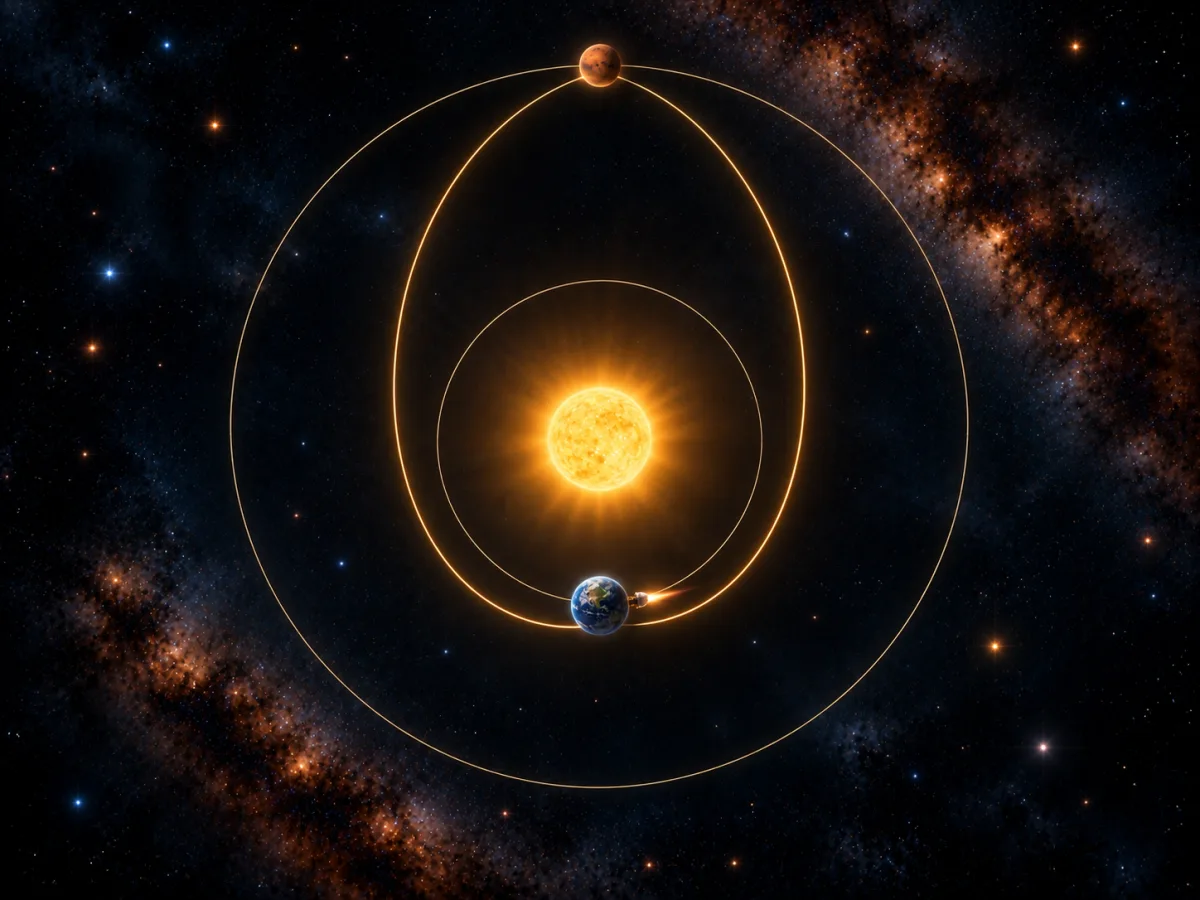
The cheapest route between two circular orbits is an ellipse that touches both: one burn to stretch your orbit out until its far end reaches Mars, and one burn at that far end to stop there instead of falling back. Measured against the Sun it costs about 2.9 km/s to leave Earth's orbit, about 2.6 km/s to arrive at Mars', and about 259 days in between.
Leaving from a parking orbit costs more than that, because you have to climb out of Earth's own gravity well on the way. Not by as much as you would guess, though: escape from 150 km is 3.2 km/s on its own, but a burn made down where the ship is already moving at 7.8 km/s buys far more than it would out in the open, so the whole departure comes to about 3.6 km/s rather than 2.9 + 3.2. That discount is the same Oberth effect that makes the capture burn at Mars worth making at the lowest point. This is why the cockpit shows two numbers: the slider sets the heliocentric burn that aims the arc, and the line under it is what leaving the parking orbit charges your tanks.
Everything that can go wrong with the departure burn is a matter of size. Burn too little and the far end of the arc never climbs to Mars' orbit — or, if you barely burn at all, the arc falls back towards the Sun. Burn too much and the arc crosses Mars' orbit and keeps going. There is exactly one size that stops where Mars is.